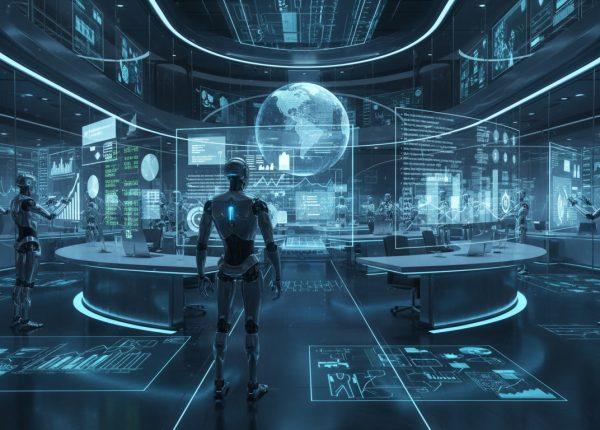
AI is changing software from interface-driven tools into autonomous systems that deliver outcomes. Instead of requiring users to navigate dashboards and trigger workflows manually, modern AI-native platforms execute goals based on intent, data, and continuous learning.
This is not a feature upgrade. It is a structural redesign of how software creates value.
What Does It Really Mean That AI Is Changing Software?
AI is changing software by replacing static, rule-based logic with adaptive systems that learn from real-world data and act independently.
Traditional software required this chain:
Human → Interface → Analysis → Decision → Action
AI-native software collapses that into:
Human → Goal → System Executes
This shift reduces operational friction and redefines the role of the user, as confirmed by insights from the Stanford AI Index..
Real-World Evidence of the Shift
Major technology platforms are already redesigning around autonomy:
Microsoft is embedding AI across Microsoft 365 to move from document editing to outcome assistance.
Salesforce is evolving CRM from record management to predictive engagement systems.
Google is shifting search toward conversational problem-solving through AI summaries.
OpenAI popularized intent-based interaction models instead of multi-step software navigation.
These companies are not just adding AI features — they are redesigning software architecture around outcomes, similar to how businesses modernize their operations with custom software solutions.
Traditional Software vs AI-Native Software
Traditional Software
AI-Native Software
Requires manual input
Executes based on intent
Fixed logic
Learns from data
Provides tools
Delivers outcomes
Reactive
Predictive
User-operated
System-operated
This comparison explains why AI is changing software at the architectural level — not just the interface layer.
From User Experience (UX) to Outcome Experience (OX)
For decades, software innovation focused on UX.
Now, the competitive advantage is OX — Outcome Experience.
Customers increasingly ask:
How quickly can this system solve my problem?
How much manual effort does this remove?
Can this run autonomously?
The less a system requires attention, the more valuable it becomes, which aligns with insights from the World Economic Forum’s AI research.
The Economic Shift Behind AI-Driven Software
AI-native platforms improve over time.
Unlike traditional systems that depreciate in value, AI systems:
Learn from accumulated data
Optimize decisions continuously
Reduce operational costs
Increase long-term ROI
This explains why investors increasingly favor AI-native SaaS models, as highlighted in the McKinsey AI adoption report
Why Many Companies Misinterpret the Shift
Common misconceptions:
“Adding a chatbot means we are AI-driven.”
“Predictive dashboards equal AI transformation.”
“Automation is the same as intelligence.”
Automation follows rules. AI adapts to reality.
Treating AI as a plugin instead of a redesign strategy creates surface-level innovation without structural advantage.
What Businesses Must Do Now
To compete in an era where AI is changing software:
1. Redesign Around Decisions
Ask what your system can decide autonomously.
2. Eliminate Workflows
AI’s greatest power is removing steps entirely.
3. Invest in Clean Data
Data quality determines intelligence quality.
4. Build Always-On Architecture
Future platforms must operate continuously without manual triggers.
5. Measure Outcomes, Not Features
Markets reward results, not dashboards.
Frequently Asked Questions
What does it mean that AI is changing software?
AI is changing software by transforming it from rule-based systems into adaptive systems that learn from data, automate decisions, and execute tasks autonomously without requiring constant manual input.
Is AI just advanced automation?
No. Automation follows predefined instructions. AI-powered systems learn patterns, adapt to new data, and improve performance without being manually reprogrammed for every scenario.
Will traditional SaaS models disappear?
What is AI-native software?
AI-native software is built from the ground up to continuously learn, adapt, and optimize performance based on real-time data and user intent. Intelligence is foundational, not an add-on.
How is AI changing software development?
AI is shifting development from coding rigid rules to training adaptive systems. Developers now design intelligent models, manage data quality, and guide AI behavior rather than manually programming every decision.
What industries are most affected as AI is changing software?
SaaS, finance, healthcare, marketing, logistics, and enterprise IT are most affected because AI-powered systems reduce manual effort, improve decision accuracy, and deliver outcomes autonomously.
How should businesses adapt to AI-native software?
Companies should redesign workflows around autonomous decisions, invest in clean data, eliminate unnecessary steps, and measure success by outcomes, as recommended by the Harvard Business Review on outcome-driven software.
Final Perspective
The most successful future software products will feel less like tools and more like invisible infrastructure.
The shift is not about intelligence alone.
It is about reduction of effort.
And that is the real reason AI is changing software.